
FNM:
A 2006 Sligh Walkthrough
By John Mason
A while ago it
was suggested that I make a full article out of a tournament report I posted on
the MTGT forum and with the current emphasis on multicolour decks it occurred
to me that maybe the possibilities of monochrome decks are being neglected. I
won that tournament playing Sligh. I will now try to explain what Sligh is, why
it’s still good, what are its weaknesses, and a little about how to play it.
I’m going to highlight the Sligh rules in burning red text.
So what is
Sligh? It is a template for a mono-red beat down deck. Sligh has been around
since 1996 when it was debuted by Paul Sligh. Whatever
format you’re building for, all you have to do is find cards to fit the slots. In some
ways it’s a bit like net decking because you have the rules to work from, but
the card choices can be all your own:
Give your
creativity an outlet!
It is good
because the whole deck is focused on a single goal:
Play
creatures and maximise the life loss caused by those creatures in the least
possible time.
There is
nothing in the deck that doesn’t contribute to the goal. Each card either can win the game on its own or
else create card advantage. Non-creature cards will be removal or
land. Combo’s are discouraged. The card ratios are based on a
numerical analysis for optimum mana usage. The simplicity has kept Sligh
winning for many years. This single-mindedness is also its downfall; there
is no plan B! If you’re still playing by the time you begin to top deck
then you have probably lost
Many
commentators have noticed that Sligh keeps popping up at even the highest
levels of competition. This says a lot for the consistency of the concept, but
it may also reflect the entry cost. You don’t need expensive cards. The core of the deck are often commons or uncommons. This is a
great deck for beginners, part-timers and anyone on a budget.
I’ll take you
through how my winning deck came about. I’ve previously done well at FNM with
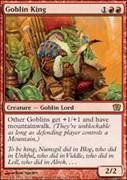
Sligh, and now I’d just completed my playset of Goblin King who I
thought could be quite strong since the recent erratum made him a Goblin. At 3
mana for 2 power he’s just eligible since creatures have or
are likely to have power equal or greater to casting cost. At 3 mana
he also fits the mana curve, I’m allowed 9-13 “1 drops”, 6-8 2cc, 3-5 3cc and 1-3 4cc
creatures.
4 Goblin
King
At this time,
pre-Coldsnap, Gatherer shows around 35 Goblins to choose from. I can eliminate
off colour cards Festering Goblin, Feral Animist and Goblin Flectomancer
immediately and also Kiki-Jiki on cost. There is only
one power > cc Goblin, and it’s a shame the drawback to Goblin Cohort makes
him unplayable without return-to-hand creatures, but the 3 slot for Viashino Sandstalker has gone and there’s no room for Glitterfang. Everything with power less than cost goes too.
I’ll cut to the chase and state that only two Goblins have real hope of
powering up, and they also work as a team. Finally I expect land destruction
and I want to play some lands of my own with sacrifice abilities.
4 Akki Avalanchers
4 Akki Raider
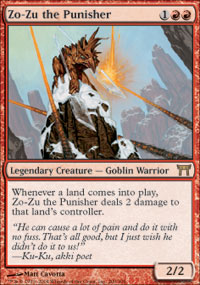
1 Zo-Zu the Punisher
Synergy is OK and Zo-Zu fits the land
theme. It’s good to keep more life than the opponent, but I should not worry
about damage myself, so I don’t ever reserve blockers. On the other hand I
like to attack unopposed.
3 Frenzied Goblin
Now remember I
said I should focus on the goal? There is the usual threat from Jitte, which I
could counter with the tried and tested Hearth Kami, but I’m fooling about with
a green splash for enchantment removal. It goes against the rules and I can
report it didn’t help (so they lose Greater Good…
there’s still Yosei) but anyway that’s how I got to
here.
I often end up
with no hand, and I’d love to be using Dark Confidant. If I was going to make a
splash my next pick would even have benefited from black. What’s better than
playing a card? Making a Goblin token. This guy is
also card advantage, and if I could have borrowed more on the night I would.
2 Rakdos
Guildmage
I have to pick
a non-Goblin for the 4 slot. Lightning Elemental is fine, but I have better.
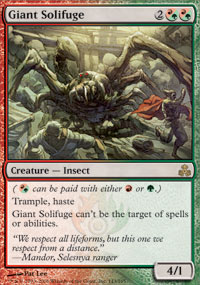
2 Giant
Solifuge
Note how the
focus on attack damage leaves me with a maximum 2 toughness? Recent play
testing proves the 1 drops are underachievers, so I
break the rules and only pick 7. I make up the difference with one sensible
card and another that was a silly experiment (and never got cast).
1 Blood Moon
1 Breath of
Fury
The remainder of the deck is removal, usually low cc burn spells. You might
use artefact or land destruction depending on the format (molten rain was a
good choice). All burn must be able to target creatures. You may use
burn to finish off a player, but always target creatures first. What I’ve chosen
all produce higher burn than casting cost. Reusable burn in
the form of ‘pingers’ like Orcish Artillery can be
useful.
4 Seal of
Fire
4 Volcanic Hammer
4 Char
Land is not as
simple as just (duh) Mountains. You may run 4-8 other land and “Man-land” is acceptable. I’ll stick
my neck out and say you should use Karoo’s to reliably reach 3 mana, even if we
don’t need the colour and despite the tempo loss. In this deck land with
sacrifice costs has possible helpful side-effects. I’ll run 24 land because I always run 24 land; good luck if you want to
try less.
17 Mountain
4 Gruul Turf
1 Ghost
Quarter
1 Quicksand
1 Shinka, the Bloodsoaked Keep
Well that’s it,
except for a suitable side board. The least valuable cards which I side out are
usually BoF, Blood Moon, Frenzied Goblin or maybe a
mountain. Against creature decks stealing their best guys is pretty funny. Artifact removal has been helpful lately, but red just
cannot handle enchantments alone. Genju gets around mass removal effects and
when attacking can end things quickly. A good selection would be 4 Threaten, 4
Genju, 4 Shatter and 3 Pithing Needle. This is what I chose instead.
4 Threaten
3 Sundering
Vitae
3 Genju of
the
1 Pithing
Needle
1 Blood Moon
1 Flames of
Blood Hand
So how does it
play? Here are the games.
 Round 1, Bogi (WURB?)
This is a
medium paced ‘goodstuff’ deck packed with quality
cards such as Ninja of Deep Hours, Burning-Tree Shaman and Simic Sky Swallower.
Game one goes to plan, and I am able to drop creatures and burn out resistance
for a fast win. The next game I depart from the plan,
use Blood Moon, and never recover the tempo after his Trygon
Predator removes it. The endgame sees Zo-Zu then
Solifuge in another rapid victory. This deck had too little control or early
threats to prevail.
Round 2,
Dale (Gruul)
This is a
completely different match where his deck is just as fast, has tougher
creatures like Kurd Ape and Scab-Clan Mauler and removal in SoF and Savage Twister. In a straight beatdown race I lose the first game. Sideboarding Threaten
just lends enough game control to produce a win in the final extra turn of the
last game. This is as close as it gets, and against a more experienced player
it would have gone the other way.
Round 3,
Matty (Greater Good)
Matty’s combo deck never had enough time to 'go
off'. Game over.
Round 4,
Darren (IzzetTron)
Another
different deck type - pure control. The first game my beat down works despite his
bounce and Pyroclasm disruption. Game 2 I take my first mulligan tonight and
cannot deal with Ryusei so I concede. Game 3 I start normally to bring him down
to 12, but then he Wildfires. With 2 signets he recovers quicker and counters
most of my spells, but I eventually manage to resolve some Goblins to get him
down to 9, and then Keiga stalls my offence. Changing my plan he lets me
resolve a Hammer to the head, but counters Char. My seal takes him to 4. Things
look bad when he taps out for Ryusei, but then I top deck Threaten FTW.
So this deck
was initially good against everything except beat down. Sideboarding helps you
become the control player. In conclusion that was a close battle; 3 rounds went
2-1 with long games. Although I made mistakes I generally had good luck.
One last thing
- Imagine my delight when I heard that Rakdos Sligh had won the 2006 Norwegian
Nationals!
Øyvind Andersen calls this Satanic Sligh:
12 Mountain
4 Sulphurous Springs
4 Blood Crypt
3 Swamp
3 Frostling
4 Dark Confidant
2 Rakdos Guildmage
2 Hearth Kami
1 Giant Solifuge
4 Genju of the
4 Seal of Fire
4 Volcanic Hammer
4 Char
4 Hit // Run
3 Yamabushi's Flame
2 Shock
Sideboard
4 Pithing Needle
4 Cruel Edict
3 Bottled Cloister
2 Giant Solifuge
2 Honden of Infinite Rage
The big surprise
here is Hit // Run. Who knew risking 8 life loss every draw can be good? Main
deck Genjus are the primary threat. He too has cut some creatures, leaned more
toward burn than most, but this is still Sligh at heart.
John